![Galerie RÉFLEXION[S]](https://galerie-reflexions.fr/wp-content/uploads/2026/01/Galerie-Reflexions_logo-fond-blanc-scaled.jpg)
Florent Bordinat
Biography and artistic approach
During my high school years, I discovered, through my classmates, a practice known as urbex, which involves exploring abandoned places in order to experience and feel things that are uncommon in everyday life. That is what appealed to us! We wanted to be afraid, to feel in danger, confronted with the world of esotericism and imagination. We wanted to discover worlds neglected by society, resembling apocalyptic sets from action films or video games. Above all, these places bear witness to the passage of time, which slips through our fingers without our being able to hold it back.
In harmony with the present, we visited these disused spaces, sometimes transformed into impressive ruins over which nature was reclaiming its rights. Places from the past that speak of the future and of the end of our humanity, serving as a warning for our time!
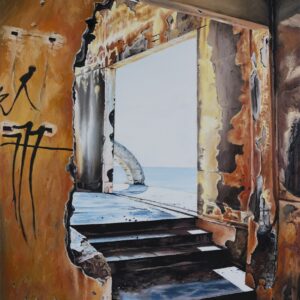
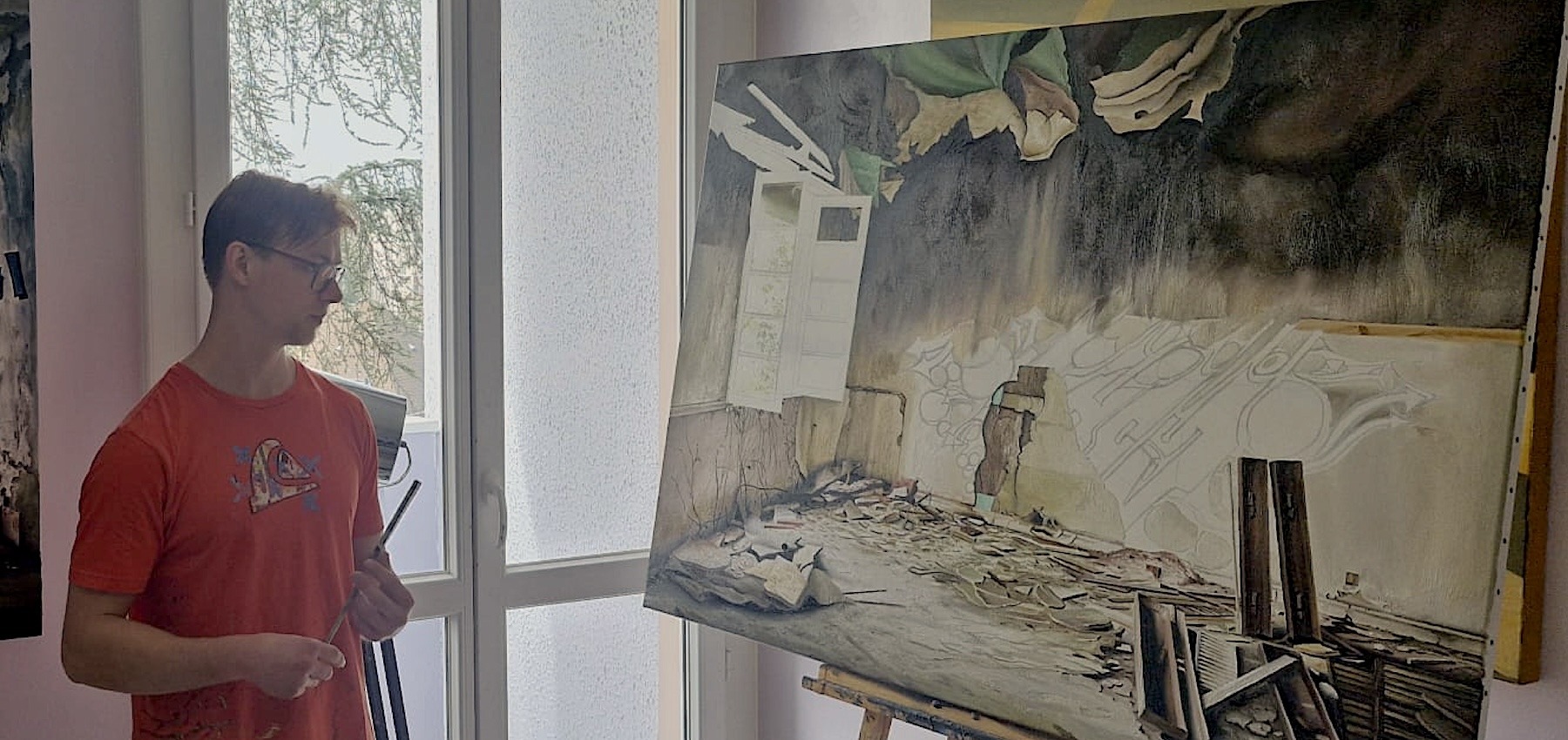
When I entered the École des Beaux-Arts in Pau in 2019, I spent a great deal of time searching for an artistic voice that would suit me. It was during my second year that the idea came to me to paint from photographs of abandoned places that I had taken during my high school years. This work was a revelation to me. I made the sets and places my own far more than if I had exhibited the photographs. I admired the contrasts that chiaroscuro could create. I was fascinated by the whitish light that entered the spaces through the windows or through the decaying roofs. I greatly enjoyed the connection to Flemish and Baroque painting. The motifs of the window and the chequered tile floor often recurred in my paintings. But what mattered to me just as much was the history of the place, its identity. Disused industrial factories fulfilled these expectations.
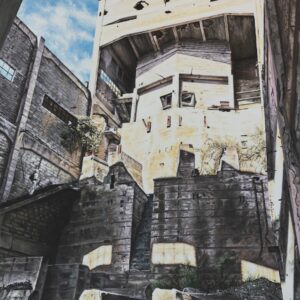
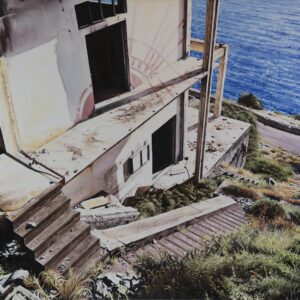
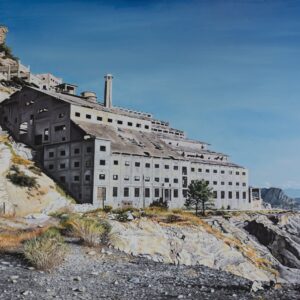
During my Master’s at the École des Beaux-Arts in Tours, I turned to the depiction of an asbestos factory in Haute-Corse. For a long time, its modernist buildings, partially in ruins, had held my attention. During my childhood, I passed them several times by car with my parents. Faced with their gigantic walls, their columns, their vaults blackened by wear, I experienced inexplicable sensations! Like an infinite melancholy, mixed with a great tragedy.
During the summer of 2022, I went to photograph these places. As I came to know them, I understood that my sensations were not insignificant. There had indeed been a terrible tragedy in this disused factory. I still did not know that, in 1964, it had been the largest asbestos factory in France and Europe. Many workers were employed there.
Through my paintings, I wish to speak of this terrible, little-known history, sometimes even forgotten. A history that Corsican workers called—and still call today—“White Hell.”
Florent Bordinat
Exhibitions
2025
Le 59 Rivoli – Paris
Salon des artistes français – Grand Palais – Paris (Bronze Medal, A. Eschbach Prize 2025)
2024
Chapelle de la Persévérance – Pau
Tarbes Biennial
Estanqu’Arts – Ici ou l’Art – Vieux-Boucau
Galerie des Corsaires – Bayonne
Promenade artistique de Molineuf
Art Shopping Salon – Carrousel du Louvre – Paris
Galerie l’Oeil du Prince – Biarritz
Galerie Sabaia – Oloron Sainte-Marie
2023
Galerie Hemon – Pau
Town Hall – Lons
Estanqu’Arts – Ici ou l’Art – Moliets-et-Maa (People’s Choice Award)
Art et lettres de France – Bordeaux
Art et lettres de France – Hourtin
Beaux-Arts – Tours
Galerie Insolitude – Pau
Exhibition at Château Jolys
2022
Carrefour des Arts – Haras de Gelos
12th edition of Festiv’Arts – Arros-Nay
Exhibition at Studio Arte Dance – Pau
2019
Exhibition at Château de Franqueville
Exhibition at La Mesclanha – Aressy
2017
Exhibition at Hôtel du Béarn – Soumoulou
2013
Opening of the Espace des Arts in Pau (Musée des Beaux-Arts and École supérieure d’art et de design des Pyrénées)